

If you play competitive shooters and have been eyeing an upgrade to your grip on the mouse itself, Razer’s 2026 refresh to its most trusted esports shape is worth your attention: the Razer Viper V4 Pro. It’s not a reinvention — it’s a full internal overhaul wrapped in the same shell players already trust.
This Razer Viper V4 Pro review breaks down the mouse from the inside out: materials, weight, feel, and real-world performance — not just numbers off a spec sheet.
Design and Build: A Shape You Can Feel From the First Second
The symmetrical, ambidextrous shape suits both claw and fingertip grips — the two styles most common in competitive FPS play. The shell is finished in a smooth-touch coating — soft and non-slip to the touch, engineered to hold its grip through long sessions without turning greasy.
The number that matters most for anyone who’s held a mouse before: weight has dropped from 54g to just 49g (50g on the white edition). Five grams sounds trivial on paper but is genuinely perceptible in hand — the mouse feels airier and quicker to redirect mid-flick compared to its predecessor. Razer credits the reduction to smaller side walls and a slimmer PCB, not just a lighter shell.
Sustainable Materials, Practical Touches
The shell is made from 90% post-consumer recycled plastic (PCR) — a meaningful environmental detail without sacrificing structural rigidity. Side buttons are physically separated to prevent misclicks during fast lateral movement, and large PTFE feet on the underside deliver notably smooth glide on both mousepads and bare desks.
Sensor: Focus Pro 50K Gen-3
The heart of the new mouse is the third-generation Focus Pro 50K sensor: 50,000 DPI, 930 IPS tracking speed, and 90G of acceleration. That DPI ceiling is essentially unnecessary for real gameplay — more than 99% of pro players run 1,600 DPI or lower — but it does guarantee consistent tracking well beyond anyone’s actual settings.
The new Frame Sync feature aligns every sensor scan with the mouse’s own reporting and USB polling cycle — an industry-first approach according to Razer. The result: motion latency as low as 0.36ms, roughly 2.5x faster than equivalent competitor mice in Razer’s own testing.
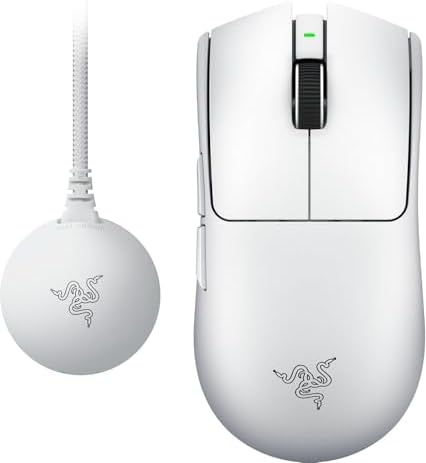
- تصميم أبيض مميز ذو أداء تنافسي لمسة نهائية بيضاء فاخرة مع نفس الهيكل فائق الخفة (≈50 جم) لحركات سريعة ودقة استهداف سلسة.
- الجيل التالي من تقنية هايبر سبيد اللاسلكية استمتع بأداء لاسلكي مستقر للغاية مع دقة استجابة 8000 هرتز لجاهزيتها للرياضات …
- مستشعر بصري عالي الدقة مزود بمستشعر ريزر Focus Pro 50K Gen‑3 للحصول على دقة تتبع ونطاق DPI لا مثيل لهما.
Switches and Scroll Wheel: 100% Optical Now
The new Gen-4 optical switches are rated for over 100 million clicks, with a tightened 0.25mm actuation distance — zero debounce delay, no double-click issues. The scroll wheel goes optical for the first time in the Viper line too, rated 3.3x more reliable than a traditional mechanical wheel, with noticeably quieter operation.
Wireless and Connectivity: A Fully Redesigned System
Razer HyperSpeed Wireless Gen-2 is over 60% more power-efficient than the previous generation and enables genuine 8000Hz polling with a 55% cut in reporting latency. The dongle itself has been redesigned into a taller, hemispherical shape for stronger signal and a weighted base to keep it planted on the desk, with three LED indicators for connection status, battery, and polling rate — readable at a glance without opening any software.
Battery and Everyday Use
Rated for up to 180 hours at 1000Hz, dropping to 44 hours at the maximum 8000Hz polling rate. A USB-C port on the front handles charging or wired play. The mouse also holds one onboard profile, so your last-used Synapse settings persist even on a machine without the software installed.
Software: Razer Synapse
Beyond basic use, Synapse unlocks Dynamic Sensitivity — finer DPI control mapped to your movement style — and Sensitivity Matcher, which ports your DPI settings directly from a current mouse without manual guesswork. A more niche but genuinely useful feature is Asymmetric Cut-Off, letting you set lift-off and landing distance independently across 26 levels — handy for anyone who repositions frequently mid-match.
Specifications
| Spec | Detail |
|---|---|
| Weight | 49g (Black) / 50g (White) |
| Sensor | Focus Pro 50K Gen-3 |
| Max DPI | 50,000 |
| Speed / Accel | 930 IPS / 90G |
| Wireless polling | 8000Hz |
| Motion latency | 0.36ms |
| Switches | Razer Optical Gen-4, 100M clicks |
| Battery | 180hrs (1000Hz) / 44hrs (8000Hz) |
| Build material | 90% recycled plastic (PCR) |
| Buttons | 6 programmable |
| Port | USB-C |
| Warranty | 2 years |
Razer Viper V4 Pro vs Logitech’s Flagships
| Spec | Razer Viper V4 Pro | Logitech G Pro X2 Superstrike | Logitech G Pro 2 Lightspeed |
|---|---|---|---|
| Weight | 49g | ~60g | ~60g |
| Shape | Ambidextrous | Ambidextrous | Ambidextrous |
| Switches | Optical Gen-4 | Haptic-based | Mechanical |
| Max polling | 8000Hz | 8000Hz | 8000Hz |
| Standout tech | Frame Sync | Tunable haptic clicks | More configurable shape |
| Best for | Lightest possible weight | Feature seekers | Larger hands |
Who Is This Mouse For?
The Viper V4 Pro is built for competitive players in fast-paced shooters like Valorant or Counter-Strike, where the light weight and near-instant response translate directly into gameplay. If you use a full palm grip, a larger mouse may suit you better — the symmetrical shape and low weight are optimized primarily for claw and fingertip styles.
Pros and Cons
Pros
- 49g — among the lightest flagship mice on the market
- 90% recycled plastic build — sustainable without sacrificing rigidity
- 0.36ms motion latency — among the fastest in its class
- Fully optical switches and scroll wheel for the first time
- 180-hour battery covers weeks of typical use
Cons
- The 5g weight cut isn’t perceptible to everyone at first pick-up
- 50,000 DPI ceiling is functionally unnecessary — marketing headroom, not real utility
- No haptic feedback, a feature some rivals now offer
- The symmetrical shape suits claw/fingertip better than full palm grips
- Flagship pricing — not the budget pick in Razer’s own lineup
FAQ
What’s different from the Viper V3 Pro?
Lower weight (49g vs 54g), a newer sensor (Focus Pro 50K Gen-3), longer battery life, Gen-4 switches, and an optical scroll wheel for the first time.
Is it good for beginners?
Technically yes, but the price targets serious competitive players. A beginner would find better value one tier down in Razer’s range.
Do I need Razer Synapse?
Not for basic use, but you’ll need it (free) to adjust DPI stages or access features like Dynamic Sensitivity.
Does it charge over the cable?
Yes — via USB-C, useful for charging overnight or playing wired directly.
Is it suitable for casual gaming?
Sure, but the price is really aimed at competitive players. Casual users will find better value elsewhere in the lineup.
The Verdict
The Razer Viper V4 Pro isn’t a design revolution — it’s a proven shape refined into a genuinely faster tool. The lighter build, newer sensor, and fully optical input path add up to a meaningful upgrade for anyone who lives inside competitive shooters, without changing the shape players already trust.
Who should look elsewhere? Anyone with a full-palm grip who wants a larger mouse, or anyone gaming casually who doesn’t need the lightest, fastest option on the market. But for weight and latency chasers in 2026, this is a strong recommendation.
Shop Razer Viper V4 Pro on Amazon UAE
Disclosure: this article contains affiliate links. Purchases made through these links may earn us a commission at no extra cost to you. Specifications sourced from Razer’s official product page and independent reviews; prices are subject to change on Amazon UAE.