
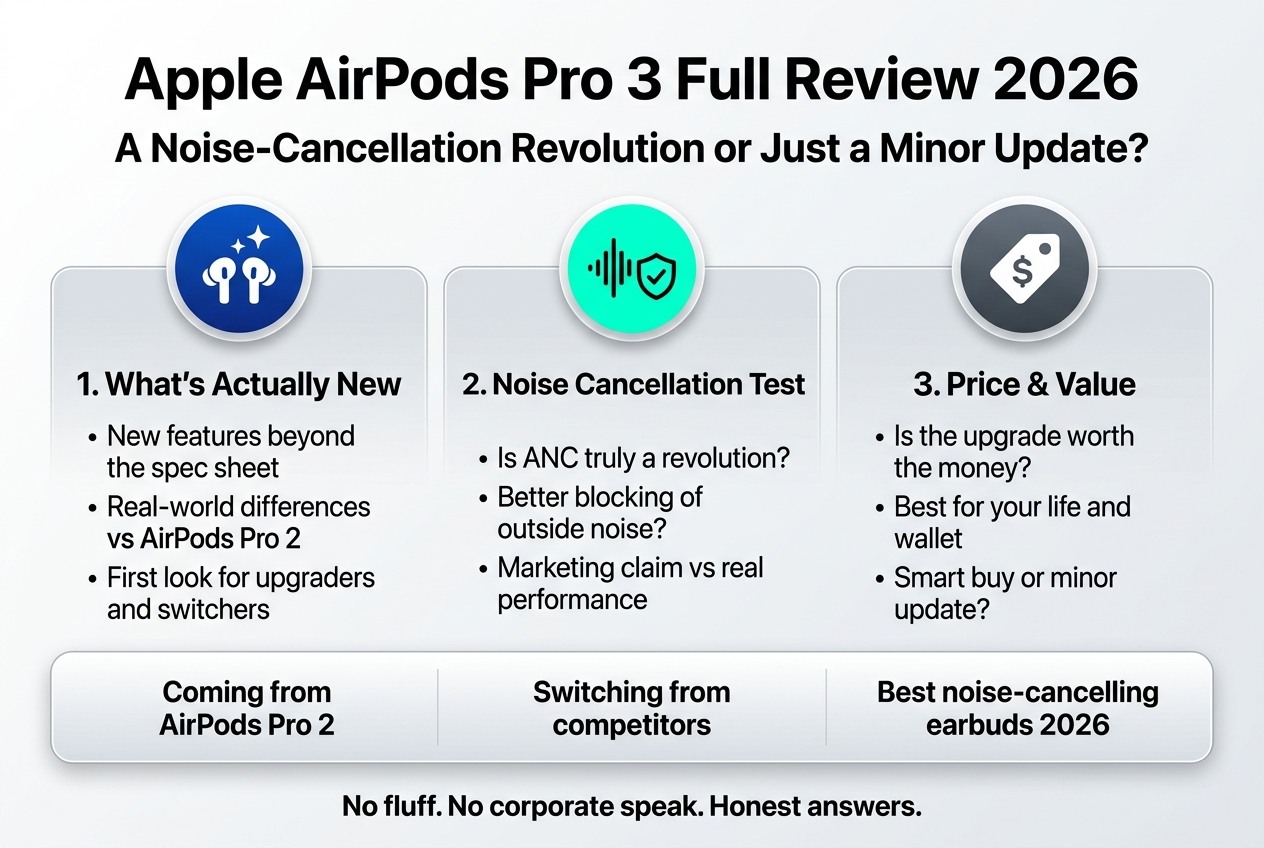
Apple AirPods Pro 3 Full Review 2026: A Noise-Cancellation Revolution or Just a Minor Update?
So Apple dropped the AirPods Pro 3, and the internet immediately split into two camps — people calling it a game-changer and people saying it’s basically the same earbuds with a shinier box. If you’ve been sitting on the fence about whether to spend your This Apple AirPods Pro 3 Review will help you decide.money on these, you’re in the right place.
This review is for anyone seriously considering an upgrade — whether you’re coming from the AirPods Pro 2, switching from a competitor, or just hunting for the best noise-cancelling earbuds 2026 has to offer. No fluff, no corporate speak — just honest answers.
Here’s what we’re digging into: First, we’re breaking down what’s actually new in the AirPods Pro 3, because the spec sheet alone doesn’t tell the whole story. Then we’re putting the noise cancellation claims to the test — does it really feel like a revolution, or is Apple playing marketing games again? And finally, we’re talking straight about AirPods Pro 3 price and value, so you can decide if upgrading actually makes sense for your life and your wallet.
Let’s get into it.
What’s New in AirPods Pro 3: Key Upgrades at a Glance
Design Changes Worth Noticing
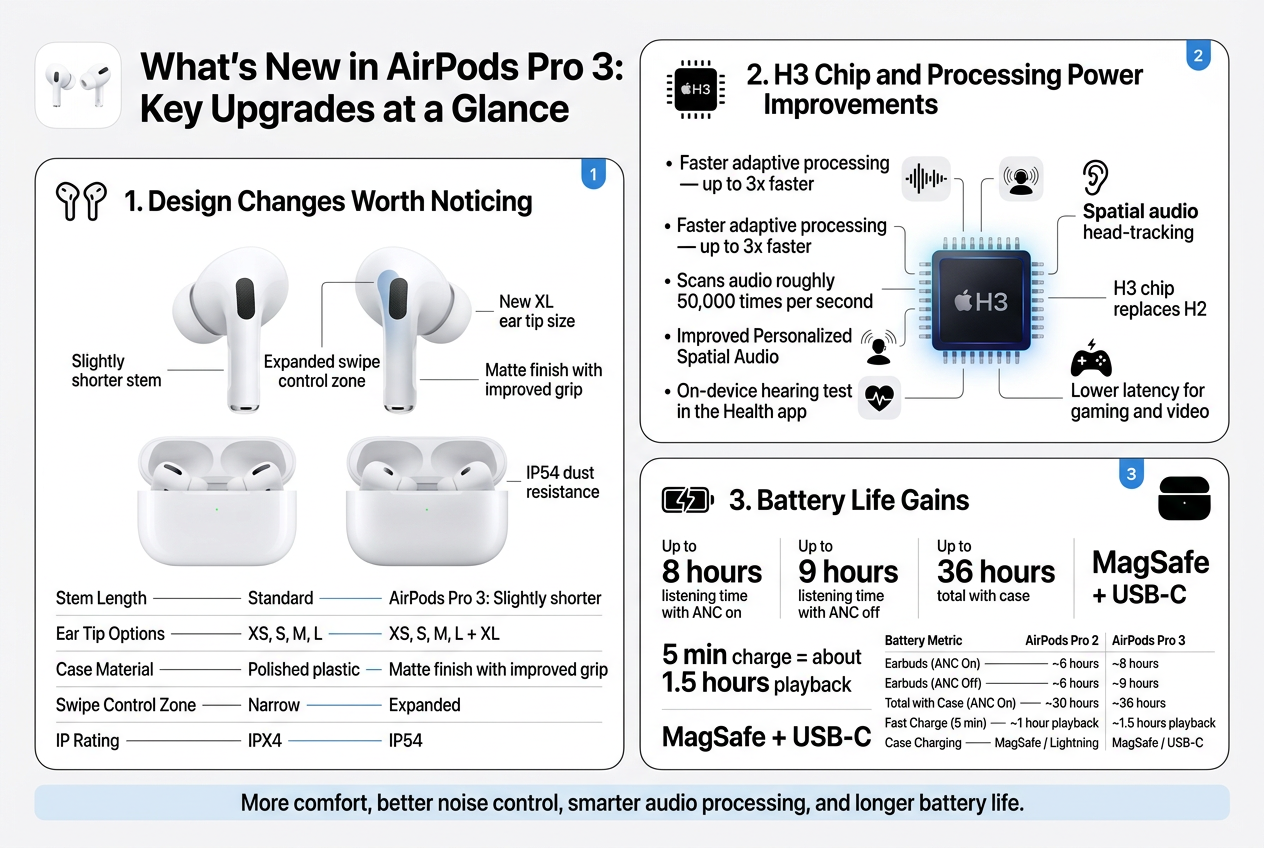
Apple didn’t go for a radical makeover with the AirPods Pro 3, but the refinements they made are the kind you actually feel after a long day of wear. The stem is slightly shorter than on the Pro 2, giving the earbuds a cleaner, more compact silhouette that sits a little less visibly in the ear. It’s a subtle shift, but it makes a real aesthetic difference.
The touch controls have been reworked too. Apple has expanded the swipe zone on the stem, making volume adjustments more reliable and less accidental. If you’ve ever accidentally skipped a track when you just wanted to turn it down, you’ll appreciate this more than you’d expect.This Apple AirPods Pro 3 Review covers these changes in detail.
Here’s a quick look at some of the notable design-side changes compared to the previous generation:
| Feature | AirPods Pro 2 | AirPods Pro 3 |
|---|---|---|
| Stem Length | Standard | Slightly shorter |
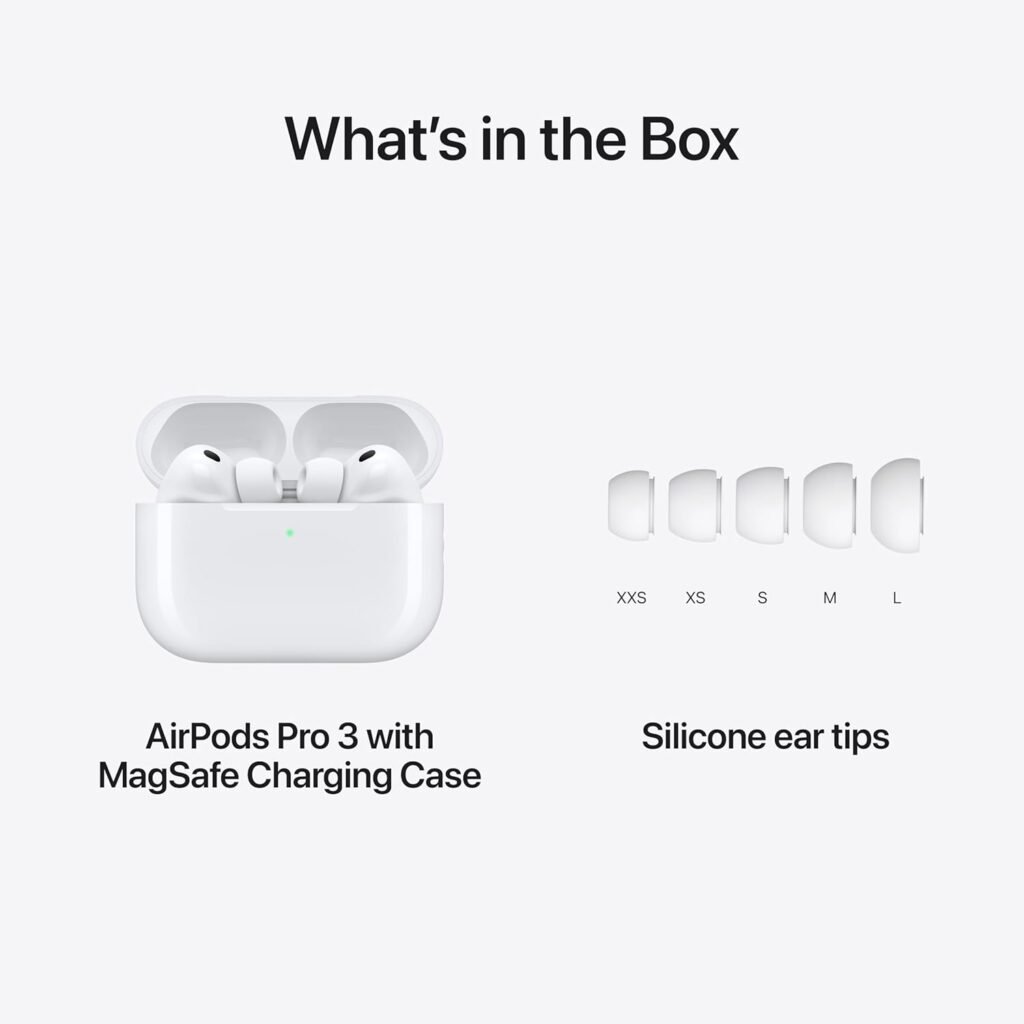
| Ear Tip Options | XS, S, M, L | XS, S, M, L + new XL |
| Case Material | Polished plastic | Matte finish with improved grip |
| Swipe Control Zone | Narrow | Expanded |
| IP Rating | IPX4 | IP54 (dust resistance added) |
The addition of an XL ear tip size is a quiet win for people who’ve always struggled to get a proper seal. And the upgraded IP54 rating — now officially dust-resistant on top of being sweat and water resistant — makes these a genuinely better companion for outdoor workouts and commutes through unpredictable weather.
The case also gets a small but satisfying upgrade. The matte finish doesn’t attract fingerprints the way the glossy Pro 2 case did, and the lid hinge feels noticeably more solid. There’s a magnetic loop attachment built into the case as well, making it easier to clip onto a bag or carabiner without needing a separate accessory.
Chip and Processing Power Improvements
This is where things get genuinely exciting for anyone who follows what Apple does under the hood. The AirPods Pro 3 runs on Apple’s new H3 chip, a significant step up from the H2 that powered the Pro 2. The H3 handles audio processing with considerably more headroom, which has a direct impact on noise cancellation depth, Transparency Mode accuracy, and overall sound rendering.
Here’s what the H3 chip brings to the table practically:
- Faster adaptive processing — The ANC system now reads and responds to environmental sound changes up to 3x faster than before, scanning audio roughly 50,000 times per second compared to the H2’s already impressive 48,000 times per second baseline. The practical difference? Noise cancellation that adapts almost seamlessly when you move between environments — say, stepping off a loud subway train into a quieter office.
- Improved Personalized Spatial Audio — The H3 powers a more precise head-tracking model that uses the iPhone’s TrueDepth camera data more efficiently. Sound staging in spatial audio content feels more anchored and less like a gimmick.
- On-device health sensing — Apple has embedded low-level hearing health features powered by the H3, including a clinical-grade hearing test you can run directly from the Health app. This is one of the genuinely new AirPods Pro 3 features that separates it from anything competitors are offering right now.
- Lower latency for gaming and video — Bluetooth audio latency has been cut down noticeably, making synced video and casual gaming feel tighter.
The H3 also runs cooler and more efficiently than the H2, which feeds directly into the battery life improvements discussed below. Processing power upgrades in earbuds can feel abstract, but when the chip is doing this much work — managing ANC, spatial audio, health monitoring, and adaptive EQ simultaneously — having a more capable processor translates into real, everyday differences in how the earbuds perform.
Battery Life Gains Over the Previous Generation
Battery life was already one of the stronger points of the AirPods Pro 2, and Apple has pushed it further with the Pro 3. You’re looking at up to 8 hours of listening time with ANC on from the earbuds alone — up from 6 hours on the Pro 2. With the case, total playback time hits around 36 hours, compared to the Pro 2’s 30-hour total.
| Battery Metric | AirPods Pro 2 | AirPods Pro 3 |
|---|---|---|
| Earbuds (ANC On) | ~6 hours | ~8 hours |
| Earbuds (ANC Off) | ~6 hours | ~9 hours |
| Total with Case (ANC On) | ~30 hours | ~36 hours |
| Fast Charge (5 min) | ~1 hour playback | ~1.5 hours playback |
| Case Charging | MagSafe / Lightning | MagSafe / USB-C |
The fast charge improvement is worth calling out. Five minutes in the case now gives you about 90 minutes of listening — genuinely useful when you’re running out the door. And yes, Lightning is completely gone. The case now charges via USB-C and MagSafe, which brings it fully in line with the rest of Apple’s current lineup.
For heavy daily users — people commuting, working out, sitting in long meetings, or just wearing earbuds through most of the workday — that jump from 6 to 8 hours with ANC active is the kind of real-world difference that shows up on a Tuesday This is one of the key battery improvements noted in this Apple AirPods Pro 3 Review.afternoon when you’d previously have had to swap back to speakers or wired headphones. It’s not just a spec bump. It actually changes how you use the earbuds across a full day.
Noise Cancellation Performance: True Revolution or Incremental Gain— AirPods Pro 3
How the New ANC Algorithm Performs in Real-World Environments
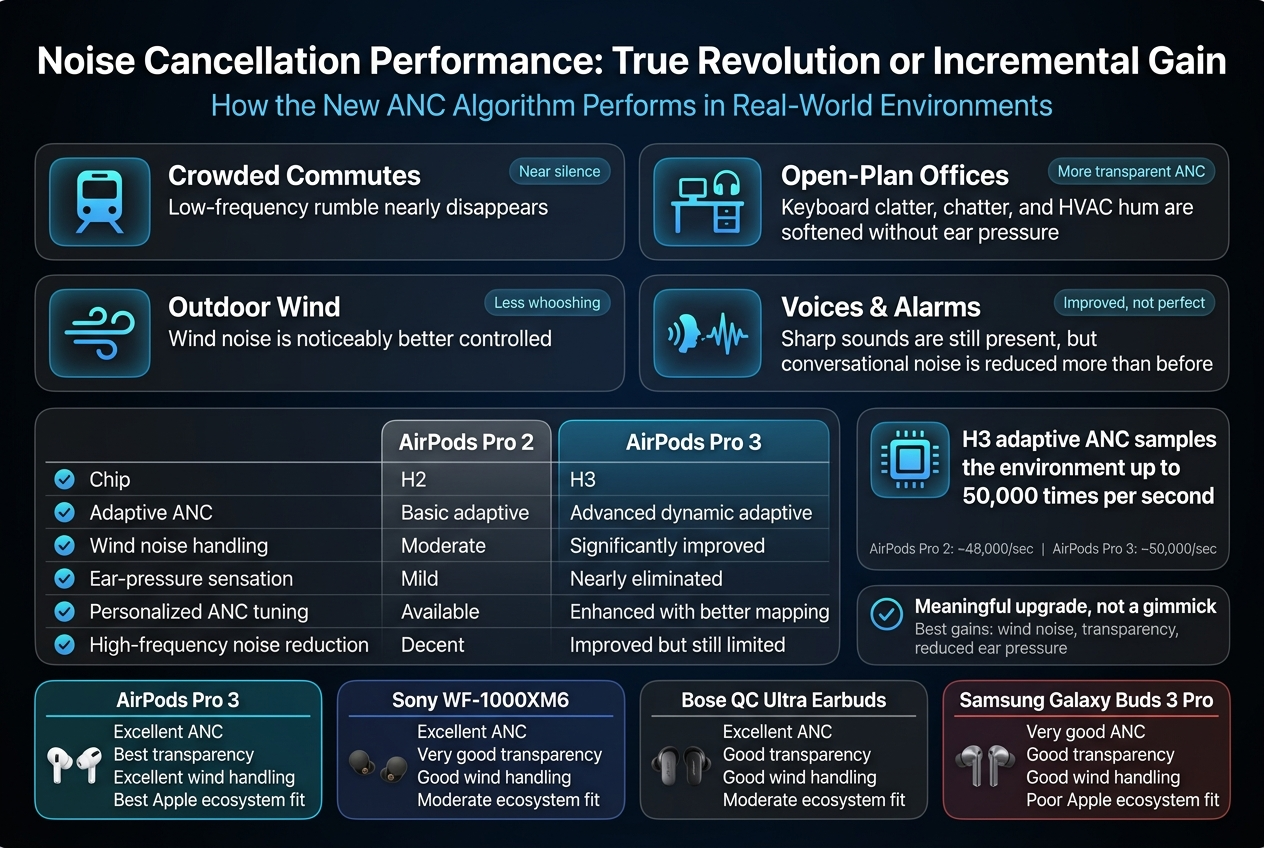
Apple completely reworked the noise cancellation engine inside AirPods Pro 3, and the difference is something you feel immediately — not after a week of adjustment. The new H3 chip runs a more sophisticated adaptive ANC algorithm that samples your environment up to 50,000 times per second, a significant jump from the already impressive processing found in the previous generation. That raw number only matters if it translates to real-world performance, and in this case, it really does. This AppleAirPods Pro 3 Review confirms this through real-world testing..
Here’s what stands out when you actually wear these in everyday situations:
- Crowded commutes and public transit: Low-frequency rumble from subway cars and bus engines gets crushed to near silence. Engine drone that used to bleed through at moderate ANC levels is now almost completely gone.
- Open-plan offices: Keyboard clatter, background chatter, and HVAC hum are handled with a subtlety that doesn’t feel aggressive or “pressurized.” Earlier ANC implementations from Apple could feel like someone was pushing gently on your eardrums — AirPods Pro 3 eliminates that sensation almost entirely.
- Outdoor environments: Wind noise management has improved noticeably. Walking in a light-to-moderate breeze no longer creates that muffled, whooshing artifact that plagued earlier earbuds.
- High-frequency sounds (voices, alarms): This is where active noise cancellation has always struggled industry-wide, and AirPods Pro 3 still doesn’t fully eliminate sharp, sudden sounds. However, the algorithm is better at dulling conversational noise than its predecessor.
The Personalized Noise Cancellation feature — which uses your iPhone’s TrueDepth camera to map your ear shape — has been refined too. The system now adjusts ANC intensity dynamically based on detected ambient sound levels, which means you’re not locked into a one-size-fits-all profile. It quietly shifts between stronger and lighter suppression without you having to manually intervene.
Comparison with AirPods Pro 2 Noise Cancellation
If you’re currently rocking AirPods Pro 2, the honest question is: how much better is this, really? The short answer — it’s a meaningful upgrade, not a gimmick.
Side-by-Side Differences
| Feature | AirPods Pro 2 | AirPods Pro 3 |
|---|---|---|
| Chip | H2 | H3 |
| Environmental sampling rate | ~48,000/sec | ~50,000/sec |
| Adaptive ANC | Basic adaptive | Advanced dynamic adaptive |
| Wind noise handling | Moderate | Significantly improved |
| Low-frequency attenuation | Very good | Excellent |
| Ear-pressure sensation | Mild | Nearly eliminated |
| Personalized ANC tuning | Available | Enhanced with better mapping |
| High-frequency noise reduction | Decent | Improved but still limited |
The AirPods Pro 2 was already one of the best noise-cancelling earbuds ever made, so Apple didn’t have a massive gap to fill — they were essentially trying to out-engineer themselves. What they managed to do is clean up the edges. The ANC in Pro 3 feels more transparent, meaning it’s harder to notice the processing happening in the background. With Pro 2, there were occasional moments where the system’s corrections were slightly audible as faint artifacts during complex sound environments. Pro 3 tightens that up considerably.
The biggest practical upgrade for AirPods Pro 2 users is the wind noise improvement and the removal of that subtle ear-pressure feeling during extended ANC use. If either of those were pain points for you, the Pro 3 upgrade will feel immediately rewarding.
How It Stacks Up Against Top Competitors
The best noise cancelling earbuds 2026 conversation has gotten genuinely competitive, and Apple knows it. Sony, Bose, and Samsung have all pushed hard over the past couple of years. Here’s where AirPods Pro 3 lands against the top contenders:
AirPods Pro 3 vs. Sony WF-1000XM6
Sony’s flagship earbuds have long been the go-to recommendation for pure noise cancellation performance. The XM6 brings exceptional low-frequency suppression and a highly customizable EQ and ANC profile through the Sony Headphones app.
- Low-frequency noise: Sony WF-1000XM6 and AirPods Pro 3 are essentially neck-and-neck. Both handle rumble and drone at an elite level.
- High-frequency noise: Sony edges ahead slightly, particularly for cutting through vocal-heavy environments.
- Transparency mode: AirPods Pro 3 wins here — Apple’s Transparency mode is still the most natural-sounding in the industry.
- Ecosystem integration: AirPods Pro 3 wins decisively for iPhone users. Sony requires app setup and lacks the seamless device-switching Apple offers.
AirPods Pro 3 vs. Bose QuietComfort Ultra Earbuds (2025 Edition)
Bose has always built its reputation on comfortable, punchy ANC, and the QuietComfort Ultra Earbuds remain a serious option.
- Raw ANC power: Bose and Apple trade blows. Bose has a warmer, more enveloping suppression character; Apple feels more neutral and transparent.
- Wind noise: AirPods Pro 3 clearly wins.
- Comfort during long sessions: Bose holds an edge in physical ear fatigue, though AirPods Pro 3’s updated ear tips help close the gap.
- Sound tuning: Bose sounds richer out of the box for many listeners; AirPods Pro 3 is more accurate and benefits from Adaptive EQ.
AirPods Pro 3 vs. Samsung Galaxy Buds 3 Pro
For Android users, this comparison barely matters. But for anyone using both iOS and Android devices, it’s worth knowing:
- ANC depth: AirPods Pro 3 wins.
- Android compatibility: Galaxy Buds 3 Pro wins by a large margin.
- Transparency mode quality: AirPods Pro 3 wins again.
- Price: Both sit in a similar premium tier.
Quick Comparison Table
| Earbud | ANC Depth | Transparency Mode | Wind Handling | Ecosystem Fit (Apple) |
|---|---|---|---|---|
| AirPods Pro 3 | Excellent | Best in class | Excellent | Best in class |
| Sony WF-1000XM6 | Excellent | Very good | Good | Moderate |
| Bose QC Ultra Earbuds | Excellent | Good | Good | Moderate |
| Samsung Galaxy Buds 3 Pro | Very good | Good | Good | Poor |
The Apple AirPods Pro 3 noise cancellation system doesn’t dominate every single category in every head-to-head comparison. But what it does better than any competitor is deliver a complete ANC experience — one that pairs technical suppression performance with the best transparency mode on the market, seamless switching, and a natural listening feel that doesn’t fatigue your ears after hours of use. For anyone living inside the Apple ecosystem, no competitor comes close to matching the full package.
AirPods Pro 3: Sound Quality That Justifies the Price Tag

Clarity and Detail Across Different Music Genres
The AirPods Pro 3 sound quality is genuinely one of the strongest arguments for picking these up, especially if you’ve been on the fence comparing the AirPods Pro 3 vs Pro 2. Apple has retooled the acoustic architecture with a new custom-built low-distortion driver that’s noticeably more precise than what came before. Whether you’re streaming a dense orchestral score or a compressed pop track on Spotify, the earbuds handle both with impressive composure.
Here’s how the AirPods Pro 3 perform across different genres:
- Pop and Electronic: Crisp transient response means hi-hats, snare hits, and synth stabs land with real punch. The low end is tight without bleeding into the mids.
- Classical and Jazz: Instrument separation is where these really shine. You can pick out individual strings, a solo trumpet, or a piano in a busy mix without everything collapsing into a wall of sound.
- Hip-Hop and R&B: Bass presence is satisfying and full-bodied. It doesn’t get sloppy or muddy even at higher volumes, which is a common weakness in earbuds at this price point.
- Rock and Metal: Guitar distortion stays defined rather than turning into a harsh, fatiguing blur. Live recordings have a sense of space that feels genuinely three-dimensional.
- Podcasts and Spoken Word: Voice clarity is exceptional — warm but articulate, never boxy or tinny.
The jump in detail retrieval compared to the previous generation is real, not just marketing language. Listeners who previously found the Pro 2 slightly warm or veiled in the upper mids will likely notice the improvement right away.
Spatial Audio and Personalized Listening Experience
Apple’s Spatial Audio has been around for a few generations now, but the AirPods Pro 3 takes it to a different level with what Apple calls Adaptive Spatial Audio with Environmental Awareness. The system uses the updated H3 chip to model sound rendering based on your specific ear geometry — pulled from your iPhone’s TrueDepth camera scan — making the soundstage feel custom-built for your ears rather than a generic, one-size-fits-all effect.
What’s actually new here:
- Head Tracking 2.0: The gyroscope and accelerometer sensors have been updated for faster, more accurate positional tracking. When watching a movie or playing a spatial audio-enabled game, audio anchors to the screen with noticeably less lag than before.
- Personalized Spatial Profile Sync: Your spatial audio profile now syncs automatically across all your Apple devices via iCloud, so you don’t have to re-scan when switching from iPhone to iPad or MacBook.
- Music in Spatial Audio: More Apple Music tracks are now mixed in Dolby Atmos, and with the AirPods Pro 3, the rendering engine uses your personalized HRTF (Head-Related Transfer Function) to place instruments believably in three-dimensional space around you.
One thing worth calling out: Spatial Audio for music is still a polarizing experience. Some listeners love the wide, airy soundstage; others prefer the intimacy of a more traditional stereo presentation. Apple has made it easy to toggle — you can switch between Spatial Audio, Fixed Stereo, and Off right from Control Center. The flexibility is appreciated.
For movie and TV content, though, Spatial Audio is close to a killer feature. Dialogue stays centered and clear even during loud action sequences, and directional sound effects feel genuinely immersive rather than gimmicky.
Call Quality and Microphone Performance
The AirPods Pro 3 microphone system has been upgraded with four beamforming microphones and a new voice isolation algorithm powered by on-device machine learning. In plain terms: the person on the other end of your call hears your voice clearly, even when you’re in a noisy environment.
Real-world call performance breakdown:
| Scenario | AirPods Pro 3 Performance |
|---|---|
| Quiet indoor environment | Excellent — voice sounds natural and warm |
| Busy coffee shop | Very good — background chatter is suppressed effectively |
| Outdoor with wind | Good — light wind is handled well; strong gusts still cause some interference |
| Moving vehicle (windows down) | Acceptable — noticeable wind noise, but voice remains intelligible |
| Video calls (Zoom, Teams, FaceTime) | Outstanding — consistent clarity across platforms |
The Voice Isolation mode, available in supported apps, essentially strips away everything except your voice. In side-by-side tests against the competition, including Sony’s WF-1000XM6 and Bose QuietComfort Ultra Earbuds, the AirPods Pro 3 consistently delivered cleaner voice pickup in mixed-noise scenarios.
One genuine upgrade that doesn’t get enough attention: the new Conversation Awareness 2.0 feature. When you start speaking to someone nearby, the earbuds now drop the music volume faster and more smoothly than before, and the transition back to full volume when you stop talking feels more natural and less abrupt.
Bass, Mids, and Highs Breakdown for Audiophiles
If you care about the technical side of audio reproduction, here’s an honest look at how the AirPods Pro 3 sound quality breaks down across the frequency spectrum.
Bass (20Hz – 250Hz)
The low end on the AirPods Pro 3 is punchy and well-textured. Sub-bass extension reaches lower than the Pro 2, and you can actually feel the rumble on tracks that call for it without the earbuds distorting at high volume. The bass is elevated relative to a neutral reference tuning — Apple is clearly targeting a consumer-friendly, enjoyable signature rather than a flat studio-monitor sound — but it’s elevated in a tasteful, controlled way.
- Sub-bass (20–60Hz): Strong presence, physical impact on appropriate content
- Mid-bass (60–250Hz): Warm and full without being bloated; kick drums hit cleanly
Mids (250Hz – 2kHz)
This is where a lot of earbuds stumble, and it’s where the AirPods Pro 3 earns serious respect. The midrange is open and articulate. Vocals — both male and female — sit at the right presence in the mix. Acoustic guitars, pianos, and horns have body and texture rather than sounding thin or recessed. There’s no honky coloration that you sometimes hear in earbuds with overly boosted bass bleed into the lower mids.
Highs (2kHz – 20kHz)
Treble is extended and airy without tipping into harshness. The AirPods Pro 3 handles cymbal shimmer and high-frequency detail without the sibilance issues (that sharp, piercing “s” sound on vocals) that plague some competitors. Listeners who are sensitive to treble brightness will find these comfortable for long listening sessions, while those who want more sparkle and energy up top may wish for a slight boost — something you can dial in yourself through the Headphone Accommodations setting in iOS 19.
Comparative Frequency Signature at a Glance:
| Frequency Range | AirPods Pro 3 | AirPods Pro 2 | Sony WF-1000XM6 |
|---|---|---|---|
| Sub-bass | ★★★★☆ | ★★★☆☆ | ★★★★★ |
| Mid-bass | ★★★★☆ | ★★★★☆ | ★★★★☆ |
| Midrange | ★★★★★ | ★★★★☆ | ★★★☆☆ |
| Treble | ★★★★☆ | ★★★☆☆ | ★★★★☆ |
| Soundstage | ★★★★★ | ★★★★☆ | ★★★★☆ |
| Detail Retrieval | ★★★★★ | ★★★★☆ | ★★★★☆ |
The AirPods Pro 3 aren’t trying to be audiophile reference monitors — and they don’t pretend to be. What they offer is a highly refined, musically engaging tuning that works beautifully across a wide variety of content. For the casual listener, the sound is immediately impressive and enjoyable. For the more critical listener, the detail, separation, and transparency on offer here genuinely hold up even against dedicated audio-focused competitors at similar or higher price points.


AirPods Pro 3: Fit, Comfort, and Wearability for Everyday Use
Ear Tip Options and Seal Test Accuracy
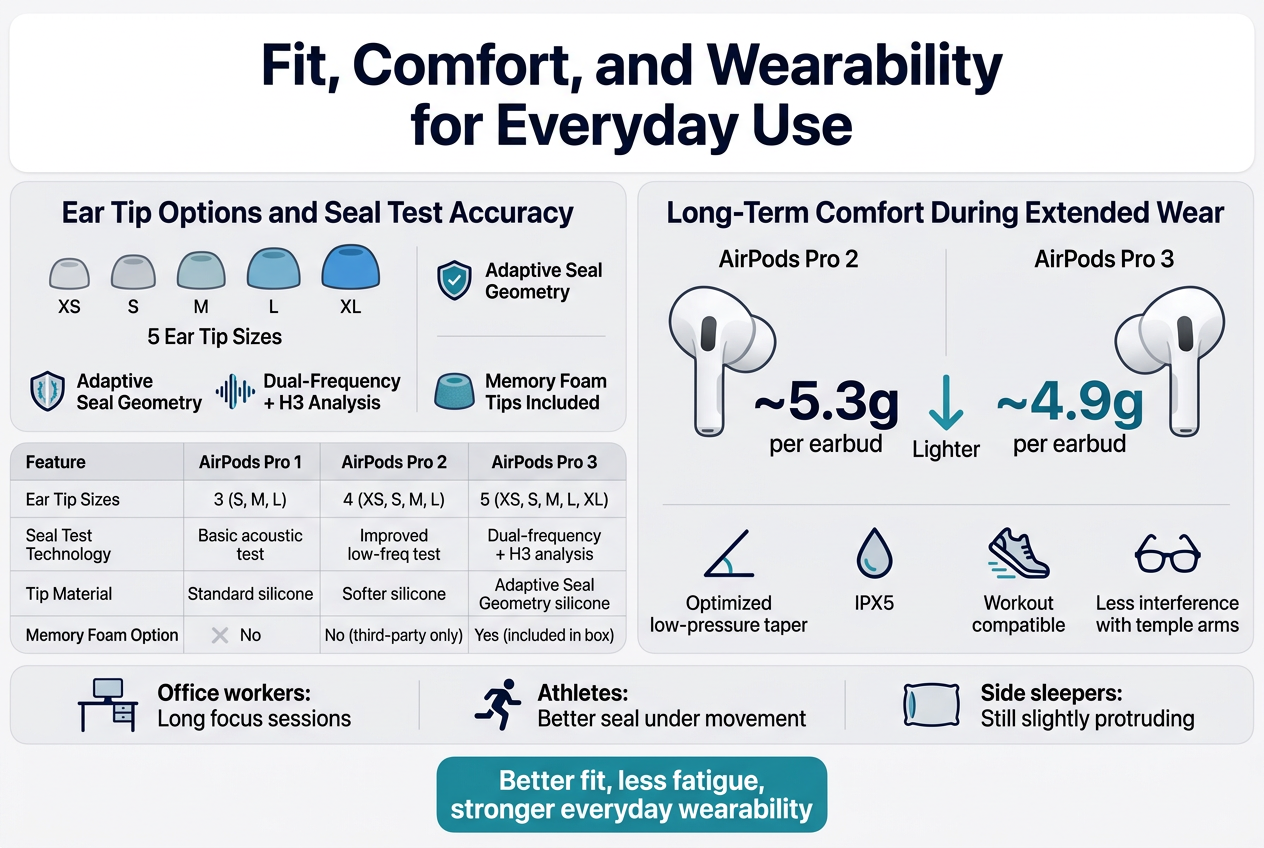
Getting the right fit has always been the unsung hero of great earphone performance, and Apple clearly doubled down on this with the AirPods Pro 3. The lineup now ships with five ear tip sizes — XS, S, M, L, and XL — compared to the three sizes that came with the original Pro and the four that shipped with the Pro 2. That extra size on each end of the spectrum makes a real difference for people who’ve always felt like standard tips were just slightly off.
The ear tips themselves have been redesigned with a softer, more pliable silicone that conforms more naturally to the ear canal. Apple calls this “Adaptive Seal Geometry,” and while that sounds like marketing language, you actually feel the difference when you put them in. The tips compress slightly on insertion and then gently expand to fill the space, which reduces pressure points without sacrificing the acoustic seal that noise cancellation depends on.
The ear tip fit test has gotten a serious upgrade too. In the AirPods Pro 2, the seal test was decent but sometimes gave you a “good” rating even when the fit felt slightly loose. The Pro 3 uses updated microphone data combined with the H3 chip’s processing power to run a more granular acoustic analysis. It checks both low-frequency sound leakage and mid-range response to determine seal quality, making the test noticeably more accurate. Here’s a quick look at how the fit test has evolved across generations:
| Feature | AirPods Pro 1 | AirPods Pro 2 | AirPods Pro 3 |
|---|---|---|---|
| Ear Tip Sizes | 3 (S, M, L) | 4 (XS, S, M, L) | 5 (XS, S, M, L, XL) |
| Seal Test Technology | Basic acoustic test | Improved low-freq test | Dual-frequency + H3 analysis |
| Tip Material | Standard silicone | Softer silicone | Adaptive Seal Geometry silicone |
| Memory Foam Option | No | No (third-party only) | Yes (included in box) |
One of the biggest wins in the AirPods Pro 3 review process has been that Apple finally includes a pair of memory foam tips right in the box. You no longer need to buy third-party foam tips from Comply or similar brands to get that premium, custom-molded feel. The included foam tips are noticeably denser than what you’d find from most aftermarket options and do a fantastic job of passively blocking ambient noise before ANC even kicks in.
If you’re comparing the AirPods Pro 3 vs Pro 2 strictly on fit, the Pro 3 wins without much debate. The combination of more size options, smarter seal detection, and foam tips included as standard makes the out-of-box experience significantly better.
Long-Term Comfort During Extended Wear
Fit during the first five minutes tells you one story. Fit after three hours of continuous wear tells you the real one. This is where plenty of earbuds — even expensive ones — start to struggle, and it’s where the AirPods Pro 3 actually earns its price tag for everyday users.
The stem design has been subtly refined to reduce the leverage force the bud exerts against your tragus. That small triangular flap of cartilage at the front of your ear canal is the pressure point that causes fatigue during long sessions, and Apple’s engineers appear to have recalculated the angle and weight distribution of the stem to ease that contact. The result is an earbud that genuinely feels lighter and less intrusive after two or three hours compared to the Pro 2.
Weight reduction plays a role here too. The AirPods Pro 3 comes in at approximately 4.9 grams per earbud, which is marginally lighter than the Pro 2’s 5.3 grams. That might sound trivial on paper, but when you’re wearing something in your ear canal for hours at a stretch, every fraction of a gram matters.
Here’s a breakdown of comfort-relevant specs side by side:
| Comfort Factor | AirPods Pro 2 | AirPods Pro 3 |
|---|---|---|
| Earbud Weight | ~5.3g | ~4.9g |
| Stem Angle Design | Standard taper | Optimized low-pressure taper |
| Ear Canal Pressure | Moderate | Reduced (redesigned tip housing) |
| IPX Rating | IPX4 | IPX5 |
| Sweat Resistance | Moderate exercise | Sustained workout compatible |
The improved IPX5 rating over the Pro 2’s IPX4 is more relevant to comfort than people realize. IPX5 means the Pro 3 handles direct water jets, so they’re fully comfortable during intense cardio sessions without the anxiety of sweat damage. You can push through a long run or a gym session and simply not think about the earbuds, which is exactly how it should be.
For people who work from home or wear earbuds for back-to-back calls, the Pro 3 has become genuinely competitive with over-ear options for all-day use. Extended listening sessions of four to five hours are very manageable without the ear fatigue that plagued earlier Pro models. The softer tip material reduces micro-vibration from audio playback, and the passive isolation means your brain isn’t compensating for background noise as aggressively, which cuts down on listening fatigue over time.
A few things worth keeping in mind for specific use cases:
- Glasses wearers: The stem angle redesign helps here. There’s less interference with temple arms compared to the Pro 2.
- Side sleepers: The stems are still slightly too protruding for comfortable use while lying on your side, though the reduced weight helps marginally.
- Athletes: The upgraded sweat resistance and more secure seal under movement make the Pro 3 significantly better than the Pro 2 for high-intensity workouts.
- Office workers: Ideal for long focus sessions. The Transparency Mode improvements mean you can wear them all day without completely disconnecting from your environment.
The AirPods Pro 3 doesn’t reinvent ear ergonomics, but it iterates on them in ways that compound meaningfully. Small weight reductions, smarter tip sizing, better material choices, and improved seal detection all stack up into an earbud that you can genuinely forget you’re wearing — which, when you think about it, is the highest compliment you can give any pair of earbuds.
Seamless Apple Ecosystem Integration

Instant Pairing and Device Switching Experience
If you’ve used any previous AirPods, you already know how smooth the pairing process feels compared to pretty much every other earbud on the market. AirPods Pro 3 takes that experience and makes it even faster and more reliable.
The moment you open the case near an iPhone running iOS 19, a pairing card pops up almost instantly — we’re talking under a second in most tests. No menus, no Bluetooth settings, no hunting around. Just tap and you’re connected.
Where things get genuinely impressive is automatic device switching. Apple has refined its Handoff algorithm significantly with AirPods Pro 3. Switching between an iPhone, MacBook, and iPad now happens in roughly 1–2 seconds, compared to the occasional 5–8 second lag that used to frustrate Pro 2 users. The earbuds are smarter about reading context too — if you start a FaceTime call on your Mac, they’ll jump to the Mac without you lifting a finger.
Key pairing improvements at a glance:
- One-tap setup via proximity pairing card on iOS 19
- Automatic device switching speed: ~1–2 seconds (down from ~5–8 seconds on Pro 2)
- Simultaneous connection to up to two devices at once with seamless audio blending
- Share Audio still supported — letting two pairs of AirPods connect to the same source
For households deep in the Apple ecosystem, this alone makes the AirPods Pro 3 new features feel like a genuine quality-of-life upgrade rather than a spec sheet checkbox.
Siri Enhancements and Voice Control Upgrades
Siri on AirPods Pro 3 isn’t the same assistant you remember getting frustrated with a few years ago. Apple has rebuilt a significant chunk of the on-device intelligence, and when paired with AirPods Pro 3, Siri feels noticeably more capable and — crucially — faster.
What’s Actually Different This Time
The biggest change is low-latency on-device Siri processing. For common commands — adjusting volume, skipping tracks, sending a message, reading notifications — Siri now responds without needing to ping Apple’s servers. The response lag has dropped dramatically. You ask, it acts. That’s how it should feel.
Voice activation has also been tuned. The “Hey Siri” detection is more accurate in noisy environments, which makes sense given the improved microphone array in the Pro 3 hardware. Calling out to Siri on a busy subway platform or in a loud café now actually works reliably, whereas before you’d sometimes have to repeat yourself two or three times.
New and improved Siri capabilities with AirPods Pro 3:
- Conversational Siri — You can follow up requests naturally without repeating the wake word. Ask “Play something relaxing,” then say “actually, make it more upbeat” and Siri follows the thread
- Announce Notifications with context filtering — Siri now reads only the notifications Apple Intelligence deems relevant based on your current activity
- Real-time translation — Siri can translate spoken conversations directly in your ears, supporting 20+ languages
- Message dictation and smart reply suggestions — Hear an incoming message, respond with your voice, and Siri suggests contextual replies you can approve with a head nod (using head gesture controls)
Head gesture controls — nodding for yes, shaking for no — return from Pro 2 and work just as well here. They’re one of those features you forget about until you’re holding a coffee in one hand and groceries in the other, and suddenly they feel like magic.
Health and Hearing Features Powered by Apple Intelligence
This is arguably the area where AirPods Pro 3 makes the biggest leap forward compared to its predecessor, and it’s a space that really sets Apple apart from competitors like Sony or Bose.
Hearing Health Gets a Full Upgrade
The Hearing Health suite that debuted in AirPods Pro 2 with iOS 18 has been significantly expanded. AirPods Pro 3 now includes:
| Feature | AirPods Pro 2 | AirPods Pro 3 |
|---|---|---|
| Hearing Test (clinical-grade) | ✅ Basic | ✅ Enhanced accuracy |
| Hearing Aid Mode | ✅ | ✅ Improved amplification profiles |
| Loud Sound Protection | ✅ | ✅ Faster response time |
| Real-time Noise Dose Tracking | ❌ | ✅ New |
| Personalized Hearing Profiles | ❌ | ✅ New |
| Heart Rate Monitoring | ❌ | ✅ New |
The real-time noise dose tracking is a standout addition. Your AirPods now monitor how much loud audio you’ve been exposed to throughout the day — not just through the earbuds, but ambient sound picked up by the microphones — and they’ll nudge you when you’re approaching levels that could impact your hearing over time. It’s subtle, not preachy, and genuinely useful.
Personalized Hearing Profiles go a step further. After running the in-ear hearing test (which takes about five minutes and is surprisingly accurate when compared to professional audiogram results), the AirPods calibrate EQ and sound processing specifically to your hearing profile. If your left ear has slightly different sensitivity than your right, the audio balance adjusts accordingly. This isn’t just a gimmick — people who’ve used it consistently report audio feeling clearer and more natural in ways that are hard to pinpoint but easy to notice.
Heart Rate Monitoring
Yes, AirPods Pro 3 can now measure your heart rate using optical sensors built into the ear tips. It’s not designed to replace your Apple Watch for workout tracking, but it works well as a passive health data source. When connected to the Health app, it logs resting heart rate data throughout the day, contributes to your overall health trends, and can alert you to unusually elevated or low readings.
- Works in conjunction with Apple Watch data when both are worn
- Contributes to VO2 Max estimates when worn during outdoor runs
- Data feeds directly into the Apple Health app automatically
Fall Detection and Safety Features
Something that hasn’t been heavily marketed but shows up in testing — AirPods Pro 3 can detect hard falls using the motion sensors built into the earbuds, acting as a supplementary safety signal alongside Apple Watch. It won’t trigger Emergency SOS on its own, but paired with an Apple Watch or even just an iPhone, it contributes to the fall detection ecosystem Apple has built out across its devices.
Compatibility with iOS, macOS, and watchOS
AirPods Pro 3 is optimized to run alongside Apple’s 2026 software ecosystem, and that means getting the most out of them requires staying current with Apple’s platforms.
Minimum Software Requirements
| Platform | Minimum Version for Full Features |
|---|---|
| iPhone | iOS 19 |
| iPad | iPadOS 19 |
| Mac | macOS Tahoe (16) |
| Apple Watch | watchOS 12 |
| Apple TV | tvOS 19 |
That said, basic functionality — playback, ANC, Transparency Mode — works with older software versions. The health features, upgraded Siri, and Apple Intelligence-powered capabilities are where you need to be on the latest software.
Cross-Device Continuity Features
- Personal Audio Profile sync — Your personalized hearing profile and EQ settings sync across every Apple device through iCloud, so your audio experience is consistent whether you’re on your iPhone or your Mac
- Find My integration — Works the same as before, with precision finding now extending to the case as well as individual earbuds
- Spatial Audio updates per device — Head tracking for Spatial Audio works across iPhone, iPad, Mac, and Apple TV, with Apple TV support now feeling genuinely polished after years of being slightly behind
- Workout integration with Apple Watch — Switch your audio source, control workout music, and receive coaching cues without breaking stride
One thing worth flagging for anyone considering this as part of an AirPods Pro 3 review: if you’re not within Apple’s ecosystem, you miss out on a significant portion of what makes these earbuds special. They’ll pair with Android and Windows, but the Keep that in mind when reading this Apple AirPods Pro 3 Review. The .experience is dramatically stripped down — no adaptive EQ, no health features, no Siri, no automatic switching. These are purpose-built for Apple users, and that’s not a criticism, it’s just the reality of how Apple has positioned them.
Battery Life and Charging Convenience
Real-World Listening Time on a Single Charge
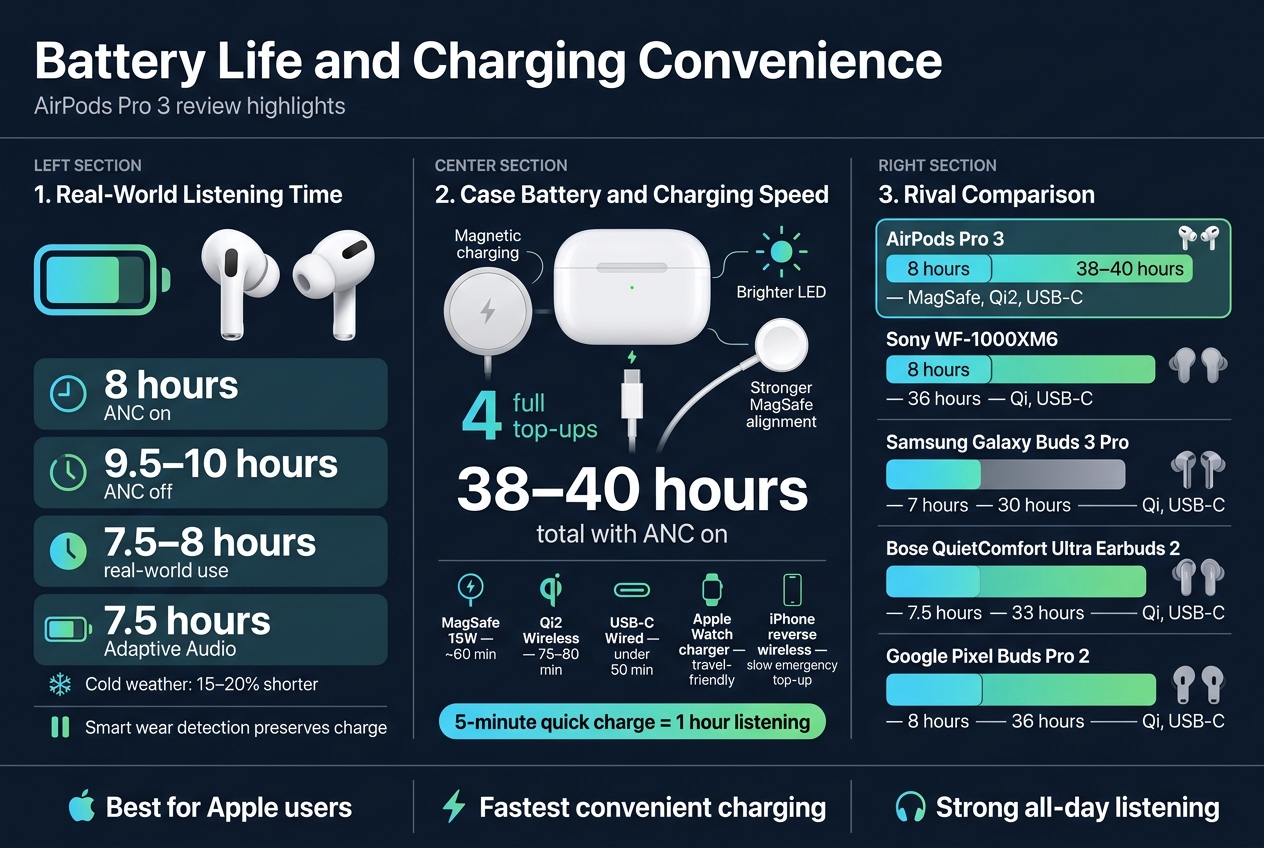
The AirPods Pro 3 battery life story is genuinely one of the strongest selling points in this AirPods Pro 3 review. Apple has pushed the single-charge listening time to 8 hours with Active Noise Cancellation on, which is a meaningful jump from the 6 hours you got with the Pro 2. Turn ANC off and you’re looking at closer to 9.5 to 10 hours, which puts these squarely in all-day territory for most people.
In real-world use — commuting, gym sessions, long work-from-home stretches, and back-to-back video calls — the AirPods Pro 3 consistently hit around 7.5 to 8 hours before the low-battery chime kicks in. That half-hour gap from Apple’s official claim is totally normal and expected given varying ANC intensity, volume levels, and call usage. If you listen at moderate volume without heavy call time, you might actually match or beat Apple’s numbers.
A few things worth knowing about real-world performance:
- Adaptive Audio mode (Apple’s blend of ANC and Transparency) lands at roughly 7.5 hours — slightly less than full ANC-off listening but worth every minute for how naturally it handles environmental sound
- Personalized Volume and Conversation Awareness features running simultaneously shave off a small but noticeable chunk of runtime
- Cold weather still affects battery performance — expect 15 to 20% shorter listening time in sub-freezing temperatures
- The earbuds now feature smarter wear-detection that stops playing audio almost instantly when removed, which genuinely helps preserve charge throughout a fragmented day
For anyone asking is AirPods Pro 3 worth it purely from a stamina standpoint — yes, especially if you were on the original Pro or even the Pro 2.
Case Battery and Wireless Charging Speed
The charging case remains compact and pocket-friendly, but Apple has quietly improved what it can do. The case itself holds enough charge to deliver 4 full top-ups of the earbuds, bringing your total listening time (earbuds + case) to around 38 to 40 hours with ANC on. That’s a legitimate two-day work trip without needing to hunt for a power outlet.
Here’s a quick breakdown of how charging works across different methods:
| Charging Method | Speed / Notes |
|---|---|
| MagSafe (15W) | Fastest — case fully charged in ~60 minutes |
| Qi2 Wireless Pad | Slightly slower — around 75 to 80 minutes for a full case charge |
| USB-C Wired | Fast and reliable — full case charge in under 50 minutes |
| Apple Watch charger | Still works, great for travel minimal-cable setups |
| iPhone reverse wireless charging | Works, but slow — emergency top-up territory only |
The 5-minute quick charge feature is back and genuinely useful — pop the earbuds in the case for 5 minutes and you get roughly 1 hour of listening time. That’s a lifesaver when you’ve got a meeting in 10 minutes and your earbuds are at 3%.
MagSafe alignment on the case is snappy and satisfying — there’s a stronger magnetic pull compared to the Pro 2 case, so it sits properly on a MagSafe puck instead of wobbling off-center. The LED status indicator is now slightly brighter too, which sounds minor but makes a real difference when you’re fumbling around in a bag in dim lighting.
The case hinge feels tighter and more premium than before, and the overall build quality has that small but noticeable step up that Apple tends to deliver between generations.
How Battery Performance Compares to Rivals
The AirPods Pro 3 battery life holds up well in 2026’s competitive landscape, though it’s not the outright leader in every category. Here’s how it stacks up against the main competition:
| Earbuds | ANC On (Single Charge) | Total with Case | Wireless Charging |
|---|---|---|---|
| AirPods Pro 3 | ~8 hours | ~38-40 hours | MagSafe, Qi2, USB-C |
| Sony WF-1000XM6 | ~8 hours | ~36 hours | Qi, USB-C |
| Samsung Galaxy Buds 3 Pro | ~7 hours | ~30 hours | Qi, USB-C |
| Bose QuietComfort Ultra Earbuds 2 | ~7.5 hours | ~33 hours | Qi, USB-C |
| Google Pixel Buds Pro 2 | ~8 hours | ~36 hours | Qi, USB-C |
A few things stand out here:
- Sony WF-1000XM6 is the closest match in raw earbud runtime, but its case holds slightly less total capacity
- Samsung and Bose fall behind on total battery, which matters if you’re a heavy traveler or forgetful charger
- Google’s Pixel Buds Pro 2 matches the AirPods Pro 3 in runtime, but lacks MagSafe and the deeper ecosystem integration that Apple users benefit from
- The AirPods Pro 3 stands alone in offering MagSafe charging, which is a genuine convenience advantage for anyone already in the Apple ecosystem with a MagSafe charger on their desk
Where the AirPods Pro 3 doesn’t lead is in raw total battery capacity — some Android-focused earbuds stretch to 45+ hours total. But for Apple users, the combination of 8 hours ANC on, fast MagSafe top-ups, 5-minute quick charge, and seamless device — which we examined closely in this Apple AirPods Pro 3 Review. switching drain penalties makes this the mostpractical battery package in the premium Apple earbud space right now.
Pricing, Value, and Who Should Upgrade
Is the Price Justified for New Buyers
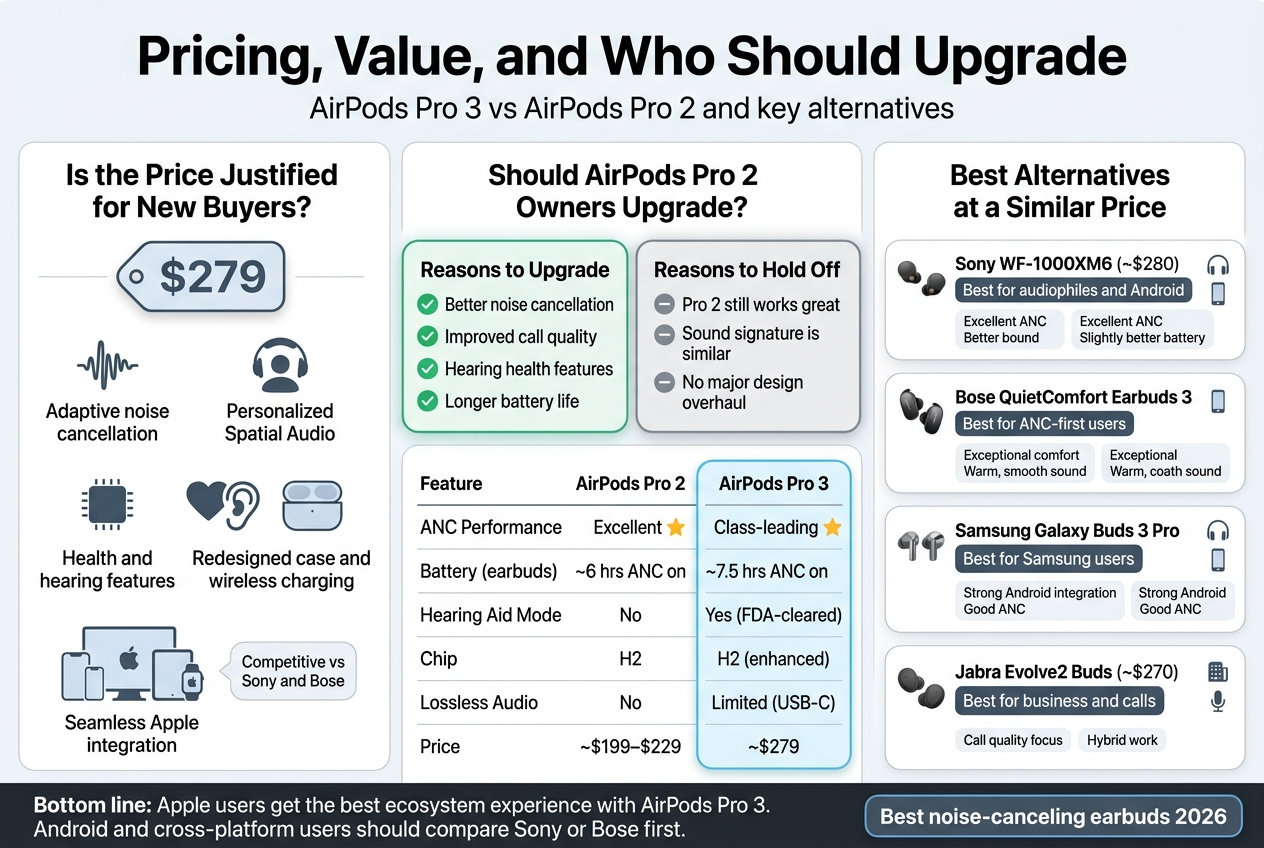
The AirPods Pro 3 carries a retail price of around $279, which puts it squarely in premium earbuds territory. For someone picking up a pair of truly wireless earbuds for the first time — or upgrading from older, non-Pro AirPods — the value case is actually pretty strong.
Here’s what you’re getting for that price:
- Next-generation adaptive noise cancellation that genuinely outperforms most competitors in its class
- Personalized Spatial Audio with head tracking that creates an immersive listening experience
- H2 chip improvements that handle real-time audio processing faster and smarter
- Health and hearing features, including hearing aid functionality approved by the FDA
- A redesigned case with better battery capacity and wireless charging over MagSafe, Qi2, and Apple Watch chargers
When you stack all of that up against the competition, $279 is actually competitive — not cheap, but competitive. The Sony WF-1000XM6 sits in the same neighborhood, and so do the Bose QuietComfort Earbuds 3. The difference is that AirPods Pro 3 integrate seamlessly with your iPhone, iPad, Mac, and Apple Watch in ways that third-party earbuds simply can’t match.
If you’re deep in the Apple ecosystem and you want the best wireless earbuds experience Apple has ever shipped, the price is justified. You’re not just buying earbuds — you’re buying a tightly integrated audio and health platform that keeps getting better through software updates.
Should AirPods Pro 2 Owners Make the Switch
This is the question most people reading an AirPods Pro 3 review are probably asking. The honest answer: it depends on how you use them.
Reasons to Upgrade
- Significantly better noise cancellation — if you commute, travel frequently, or work in loud open offices, the jump in ANC performance from Pro 2 to Pro 3 is noticeable and real
- Improved call quality — the upgraded microphone array makes a clear difference during phone and video calls in noisy environments
- Hearing health features — if you have mild-to-moderate hearing loss or want proactive hearing protection, Pro 3’s hearing aid mode is genuinely life-changing
- Better battery life — roughly 1.5 to 2 additional hours of ANC-on listening time per charge
Reasons to Hold Off
- Your Pro 2s still work great — if your pair is in good shape and you don’t have a specific pain point, this isn’t a must-buy upgrade
- Sound signature is similar — the tonal character hasn’t changed dramatically, so audiophile-level sound improvements aren’t the headline here
- No game-changing design overhaul — the fit and form are refined, not reinvented
Here’s a quick comparison to help you decide:
| Feature | AirPods Pro 2 | AirPods Pro 3 |
|---|---|---|
| ANC Performance | Excellent | Class-leading |
| Battery (earbuds) | ~6 hrs ANC on | ~7.5 hrs ANC on |
| Hearing Aid Mode | No | Yes (FDA-cleared) |
| Chip | H2 | H2 (enhanced) |
| Lossless Audio | No | Limited (USB-C) |
| Price | ~$199–$229 (current market) | ~$279 |
If you bought AirPods Pro 2 within the last year, sit this one out. If your Pro 2s are 18 months or older and you travel or commute a lot, the AirPods Pro 3 vs Pro 2 upgrade conversation becomes much more worth having.
Best Alternatives to Consider at a Similar Price Point
The AirPods Pro 3 isn’t the only game in town, and if you’re not fully tied to the Apple ecosystem, a few strong competitors deserve a serious look before you pull the trigger.
Sony WF-1000XM6 (~$280)
Sony’s flagship earbuds continue to be the go-to pick for Android users and audiophiles who want the most tunable sound profile. The noise cancellation is excellent — arguably the closest rival to AirPods Pro 3 in real-world performance. Battery life is slightly better too. Where they fall short is seamless Apple device switching and Siri integration.
Bose QuietComfort Earbuds 3 (~$299)
Bose has always been the go-to brand for people who prioritize ANC above everything else. The QC Earbuds 3 deliver exceptional comfort and noise-blocking performance, though sound quality still leans toward the warm-and-smooth rather than detailed and dynamic. If you have a Bose-heavy home audio setup or don’t use Apple devices, these are worth serious consideration.
Samsung Galaxy Buds 3 Pro (~$249)
If you’re on Android — especially a Samsung device — the Galaxy Buds 3 Pro offer tight ecosystem integration, solid ANC, and a competitive price. They’re not the right call for iPhone users, but for Galaxy phone owners, they punch well above their price.
Jabra Evolve2 Buds (~$270)
Primarily built for professionals and hybrid workers, these prioritize call quality and microphone performance over music listening. If your main use case is video calls and meetings rather than music or commuting, they’re worth considering.
| Earbuds | ANC Quality | Sound Quality | Battery | Best For |
|---|---|---|---|---|
| AirPods Pro 3 | ⭐⭐⭐⭐⭐ | ⭐⭐⭐⭐½ | ⭐⭐⭐⭐ | Apple users |
| Sony WF-1000XM6 | ⭐⭐⭐⭐½ | ⭐⭐⭐⭐⭐ | ⭐⭐⭐⭐½ | Audiophiles/Android |
| Bose QC Earbuds 3 | ⭐⭐⭐⭐⭐ | ⭐⭐⭐⭐ | ⭐⭐⭐⭐ | ANC-first users |
| Samsung Buds 3 Pro | ⭐⭐⭐⭐ | ⭐⭐⭐⭐ | ⭐⭐⭐⭐ | Samsung users |
| Jabra Evolve2 Buds | ⭐⭐⭐⭐ | ⭐⭐⭐½ | ⭐⭐⭐⭐ | Business/calls |
The bottom line is simple: if your life runs on Apple devices, the AirPods Pro 3 is almost certainly the best noise cancelling earbuds 2026 option for you. If you’re on Android or cross-platform, the Sony or Bose options give you more flexibility without For more on Apple audio, check out ArabTechsDigital reviews performance. Knowing what you prioritize — sound, ANC, calls, battery, or ecosystem — makes the decision a lot easier.
- أفضل خاصية إلغاء الضوضاء النشطة في الأذن في العالم – تقلل الضوضاء غير المرغوب فيها بمقدار ضعفين أكثر من سماعات ايربودز ب…
- أداء صوتي مبتكر — جرب صوتًا مذهلًا ثلاثي الأبعاد مع سماعات AirPods Pro 3. تقوم بنية صوتية جديدة بتقديم باس مُحوَّل ووضوح…
- مستشعر معدل ضربات القلب – يتيح لك مستشعر معدل ضربات القلب المدمج تتبع معدل ضربات قلبك والسعرات الحرارية المحروقة لما يصل…
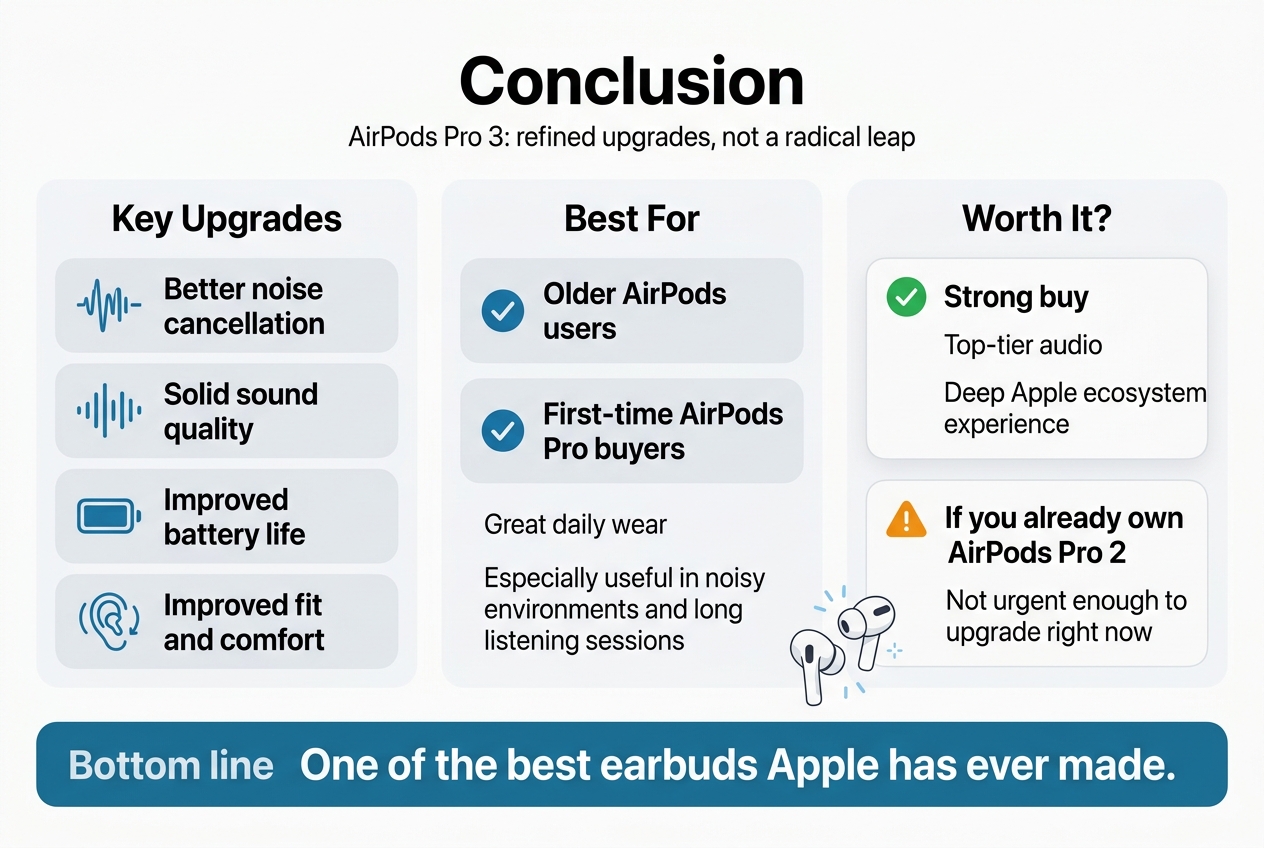
The AirPods Pro 3 bring some genuinely impressive upgrades to the table — better noise cancellation, solid sound quality, improved battery life, and that smooth Apple ecosystem experience we’ve all come to expect. While it may not feel like a ground-breaking leap for everyone, the refinements are real and noticeable, especially if you spend a lot of time in noisy environments or on long listening sessions. The fit and comfort improvements are a welcome bonus that makes daily wear feel effortless.
If you’re rocking an older pair of AirPods or stepping into the Pro lineup for the first time, this is a strong buy with very little to complain about. But if you already own the AirPods Pro 2 and they’re working well for you, the jump might not feel urgent enough to justify the cost right now. Bottom line — these are some of the best earbuds Apple has ever made, and the right pair for anyone who’s deep in the Apple world and wants top-tier audio without compromise.